Sunday, March 3, 2013

Equator

After our visit to Yunguilla, we made our way to the Intinian Museum on the equator. It was somewhat of an odd museum. Our first stop with the tour guide was to view a tomb of sorts, followed by "experiments" while on the equator, and concluded by seeing some shrunken heads. Odd...

Our tour guide conducted a series of experiments to demonstrate phenomenon felt or observed while on the equator. First they demonstrated how water drains from a sink on the equator as compared to 10 feet south of the equator. They attribute the change in how water drains to the Coriolis effect. Here is a summary of the experiment. They started with water in a sink with three small leaves floating on the surface. They pulled the plug, allowing the water to drain  into a bucket below. While on the equator, the water appeared to flow straight down and the leaves did not "swirl" in the water. They moved the sink about 10 feet away from the equator and repeated the experiment. While the water was draining out this time, the leaves did "swirl" . Wow... the proximity to the equator impacts the direction to which water swirls. Actually, it doesn't! Check out this link for a break down of this phenomenon!
Sink where the impact of the Coriolis effect and the proximity to the equator was tested. 
Our tour guide conducted a few more experiments. One compared your strength to resist your arms being pulled down on the equator and a few feet away. We also tested being able to walk a straight line with our heads tilted toward the sky. Then there was trying to stand an egg on a flat part of a nail head. I found a YouTube video for you to see these experiments and their results in action. 

Visit to Yunguilla

On Monday, February 18th, we visited the community of Yunguilla, a conservation community. This community is located in a cloud forest, north of the city of Quito. A cloud forest is a forest area that is typically covered in clouds or mist. They are found within subtropical, mountainous areas. Due to being in higher elevations, they experience cooler temperatures.  One of the more important features of this type of ecosystem is that the trees are able to draw moisture from the clouds, which bring in the majority of freshwater into the ecosystem.


Back in 1995 the community of Yunguilla began its conservation and sustainability efforts. In terms of sustainability, the community began jam and cheese making operations. Using fruits and milk produced in the community, they create jam and cheese that they are able to sell. We were able to taste both products and they were delicious. The jam as made just from fruit and sugar, with no artificial preservatives or flavors. I brought a jar of the strawberry jam home and enjoyed some this morning on my multi-grain english muffin. Delicioso! 
Path leading to the jam "factory".
Toby stirring uvilla, a fruit similar to gooseberries, and sugar over heat to make some delicious jam.
Preparing chihualcan to make jam.
Jars of strawberry jam ready to sell.
 This community has numerous conservation activities in place. They have a nursery to begin replacing some of the native plants and trees lost from deforestation. They also have a greenhouse where they grow some exotic, but indigenous orchids. The reforestation project is immensely important. With the loss of trees, there will be loss of freshwater into the ecosystem. As noted earlier, the trees are responsible for drawing water from the clouds and bringing it as a major contributor to freshwater for the area.  Lastly, they are quite the recyclers. There are many bins located through out the community to separate organic and non-organic materials. 
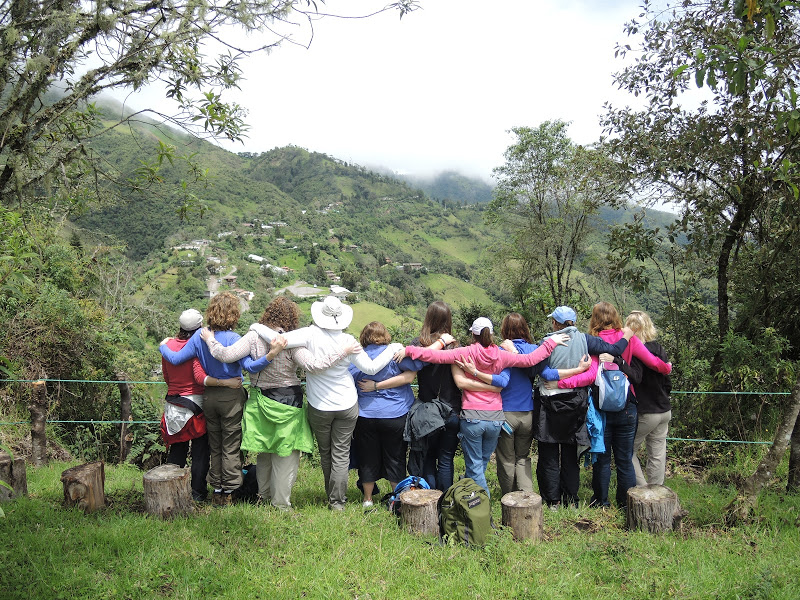
Group photo with community of Yunguilla in the background.
Our group taking in the beauty of the community.

Community of Yunguilla
 
Example of one of the many orchids in the greenhouse.
More orchids. Aren't they beautiful?!

Our tour guide, Galindo, explaining about the plants within the nursery and their reforestation project. 

Here you can see their organic and non-organic trash bins. Toby and I doing our part.

Days 4 & 5

On Day 4 we departed the Amazon to begin our journey to the city of Otavalo. We boarded a bus in the morning and headed back up into the mountains. Otavalo is over 8,000 feet above sea level. The roads leading there were full of twists and turns as we made our way around and up the mountains. The scenery was beautiful as well.
View from the highway between Tena and Otavalo. You may be able to make out the road we came down across the way.

Along our way to Otavalo we stopped to have lunch at a restaurant in Baeza. Our meals were typical of the Ecuadorian culture. For lunch on day 4 we enjoyed a chicken based souped with yucca, which is a root vegetable similar to potato. The second course included lentils, rice, fish, avocado, and some vegetables. This was followed up with a chocolate covered banana. 


After lunch we boarded the buses again and headed for a second stop over to the Papallacta Hot Springs, Termas de Papallacta. Here we found hot spring pools and cooling pools to enjoy. Papallacta is near two volcanoes, Cayambe and Antisana, which supply the energy to heat the springs. After this brief stop, we continued on to Otavalo. 

Our first morning in Otavalo was a memorable one. We were able to enjoy breakfast while hearing from Maria, one of the the authors of the pre-tour book that we read, The Queen of Water by Laura Resau and Maria Virginia Farinango. This book is about Maria's life and it was truly inspirational to hear directly from her. 
Maria Virginia, left, in traditional dress.
Following Maria's talk, we ventured out the famous artisan market. Here the indigenous otavaleños sell their handmade wares which include ponchos, scarves, art work, wood work, and more. I was able to purchase a scarf made from a man who has been making and selling scarves and other handmade goods for the majority of his life. He had a photo album of his "shop", which was nothing more than having a loom in his home. He was proud of his craftsmanship and I was happy to purchase a couple of items from him. 

We left Otavalo to head back to Quito. We stopped along the way to visit Bosque Protector Jerusalen, a dry forest. We were able to take in the beauty of park via one of its footpaths. Here we learned about the flora and fauna unique to this ecosystem. There were a variety of cacti and an agave-like plant called penco. Penco has a variety of uses, one that I found interesting is that they used the leaves as soles for shoes. 
 Penco, an agave-like plant.
Prickly-pear cactus in bloom.

After leaving the park, we boarded the buses once again to continue our trip back to Quito. We stayed at the Hotel Reina Isabel and were reunited with our luggage that could not accompany us on our trip to the Amazon. 

Saturday, February 16, 2013

More on Days 1-3

I am currently in the city of Otavalo in Ecuador, staying at the Hotel Indio Inn and they have wi-fi! I would like to take advantage of this opportunity to share a bit more of journey with you and specifically the most important part of the journey which was the visit to the amazon community of Pakay Chicta.

We arrived in this community on Friday. We brought with us four suitcases filled with supplies for the school children and their teachers. However, the more rewarding part was he service we were able to preform for them and the relationships we were able to build in that short time. One of my contributions was building two bookcases, one of which is pictured with some supplies that I placed on the shelves.

Please allow me to share a few pictures now with greater explanations to follow once I have a better wireless connection.


Thank you to Lynne and Katelyn for helping to build the bookcases. We could not have done it if it were not for Segundo!

Days 1-3, February 13-16

On February 13th I left Boston to begin my Ecuador Adventure. I am sharing this trip with 21 educators from Massachusetts. Our first day was a long day of travel. We flew out of Boston with a connecting flight in Houston before arriving in Quito, Ecuador. Our first night was spent at the Hotel Isabel Reina in Quito. After a quick 5 hour sleep, we were back on the road to head into the Amazon.

Our drive into the Amazon was an interesting one. The roads were windy with many changes in elevation. The bus ride took over 5 hours, but we did stop for lunch along the way. Our lunch started with soup made from chicken, plantains, and yucca followed by rice, lentils, and flank steak. They had a wonderful hot sauce that complimented the soup and steak well.

We arrived in Tena by the Napo River late in the afternoon. We then took long boats down river to the Bosque Protector, an animal rescue center. Our boat ride was rather eventful as we were stuck for a few moments on rocks in a rapid and we almost tipped over in another rapid. We went into the rapid sideways and a wave came over the edge. A few of us, myself included, got a it wet.

When we finally arrived at the rescue center, we were able to tour the AmaZOOnica to see and learn about what animals they were helping. The birds were numerous, ranging from parrots to scarlet macaws. Many of the birds were pets that were found in restaurants or left behind in homes or hotels. Some of the birds had their wings clipped and were unable to fly so they have no chance of being able to leave the center and return to their natural habitat. We saw many other species of animal as well. There were many turtles, some in pens but many were roaming about the trails in the center. In addition to the turtles were saw woolly monkeys, spider monkeys, cayman, and more.

I will update about the school visit the next chance I am able to access wi-fi.


Tuesday, February 12, 2013

Tick Tock...

Well it is February 12th and I am about 15 hours away from beginning my Ecuador Adventure. The countdown clock is certainly starting to tick a little louder as my departure time approaches! My excitement about this trip is building more with each passing second. I am all packed and ready to roll!

I am eager for so many aspects of this trip, but none so much as being able to visit a school in the Amazon. I have so many questions going through my mind about this leg of the trip. What does the school look like? What resources do they have? Do they have schedules similar to ours? What are the relationships like between the teacher and the students? I just want to be a fly on the wall and observe what a normal school day looks like for these kids. I am sure that our visit will interrupt their day, but I hope to be able to see and feel what their days are like.

I have visited schools outside the United States before. The one that struck me most was in the interior of the Dominican Republic. My husband and I went on a tour in which we stopped at two different schools. The obvious take-a-way from this was to compare these schools to the good ole U. S. of A. and focus on what these schools did not have. However, that wasn't my take-a-way. I struck by what they did have. They had rich learning taking place with eager students and great teachers. It reinforced with me that educators are capable of having a profound impact upon their students no matter the conditions or resources available. Great teacher are great ten days out of ten, as our friend Todd Whitaker would say.

I am looking forward to visiting the school in the Amazon. I am sure that it will impact me just as much, if not more, than the school in the Dominican and empower me to do even more for the students and staff of the Middleborough Public Schools.


Sunday, February 10, 2013

Testing Technology

In preparation for my trip to Ecuador, I thought it would be wise to check out the technology that I am bringing with me. I am bringing my iPad in it's keyboard portfolio, Nikon Coolpix s9100 digital camera, and an adapter to connect the camera to my iPad. I want also wanted to make sure that I can use the Blogger app to post and publish my uploaded photos.
If all goes well, you will see images I took this morning of the front of my house and down my driveway. The wind and snow from winter storm Nemo took a toll on fir trees. We actually went out during the storm on a couple of occasions to get as much snow as we could off the trees, but they still took a beating. We are luckier than many however. I know that there are families out there without power, and thus many without heat, since Friday night.
It appears that my iPad is easy to use to blog and upload pictures. I hope that I will have intermittent access to wifi on the trip to share my story and images, if not you will have to wait until I return!